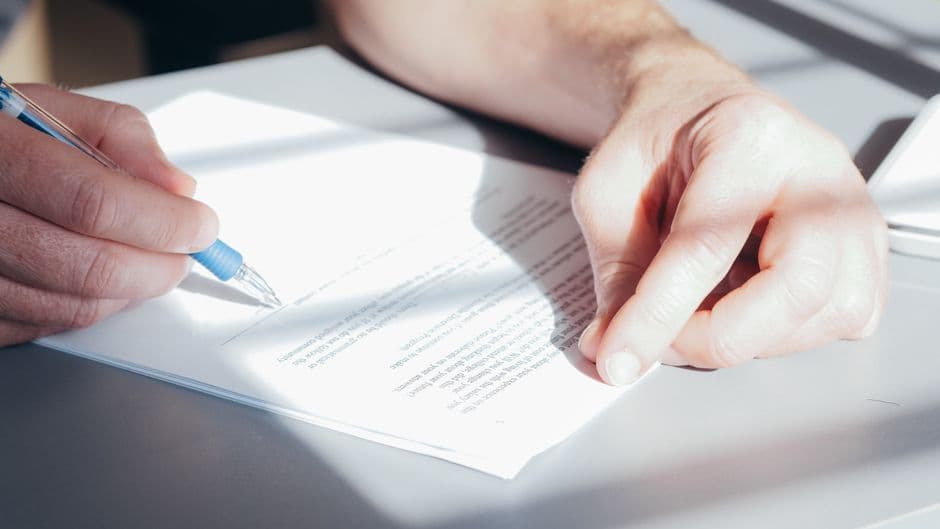
Affidavit Lawyer Dubai: Drafting Sworn Statements for UAE Courts
An affidavit lawyer in Dubai prepares legally sworn statements that meet UAE evidence requirements for use in civil, commercial, and court proceedings.
The article explains what an affidavit is, when it is required in Dubai, and the legal framework governing its use under UAE Federal Decree-Law No. 10 of 2022. It details the steps to draft a valid affidavit, the role of the notary public, and how affidavits function in commercial litigation. Readers also learn about the penalties for false statements and practical tips for ensuring admissibility in UAE courts.
Reviewed by Mohamed Noureldin, Founder, Managing Partner & Senior Legal Consultant
An affidavit lawyer in Dubai prepares sworn statements for use in civil, commercial, or court proceedings under the UAE Federal Law on Evidence (Federal Decree-Law No. 10 of 2022) and the Dubai Courts' procedural rules, serving individuals and businesses across the Emirate.
Related Services: Explore our Consumer Protection Disputes and Courts Litigation Services services for practical legal support in this area.
WHAT IS AN AFFIDAVIT AND WHEN IS IT REQUIRED IN DUBAI?
An affidavit is a written statement made under oath, signed before a notary public or authorised officer, confirming that the declarant believes the contents to be true. Under UAE Federal Decree-Law No. 10 of 2022 on Evidence, an affidavit may be submitted as documentary evidence when a party needs to prove facts that are not otherwise available, such as identity, residence, or the execution of a contract. In Dubai, affidavits are commonly required for property transfers, bank account openings, visa applications, and court-filed pleadings where personal appearance is impractical. The declarant must appear before a notary, present valid Emirates ID or passport, and swear that the statement is true; the notary then affixes a seal and records the act in the notarial register. Failure to follow this procedure renders the affidavit inadmissible, as the Dubai Courts have held that only notarised statements satisfy the evidentiary requirement (see Dubai Court of Cassation ruling 2021/123). Costs typically include a notary fee of AED 150-250 per document, plus any translation charges if the affidavit is drafted in a language other than Arabic.
HOW DOES ONE DRAFT A LEGALLY VALID AFFIDAVIT IN DUBAI?
A legally valid affidavit must contain the declarant's full name, nationality, Emirates ID number, residential address, a clear statement of facts, the declarant's signature, and the notary's jurat confirming the oath was taken. The UAE Federal Decree-Law No. 10 of 2022 requires that the affidavit be written in Arabic or accompanied by a certified Arabic translation; the Arabic text prevails over any translation. The declarant must state that they are making the statement voluntarily, without coercion, and that they understand the legal consequences of false swearing, which under Article 256 of the UAE Penal Code attracts imprisonment of up to two years or a fine. Drafting best practice is to use numbered paragraphs, avoid legal conclusions, and limit each fact to a single, verifiable point. Supporting documents-such as copies of contracts, utility bills, or passport pages-should be exhibited and referenced in the affidavit. The notary will verify the exhibitis before administering the oath. Total preparation time varies: a simple affidavit may be completed in one hour, while complex commercial affidavits involving exhibits can take several hours and require coordination with counsel to ensure relevance and admissibility.
WHAT IS THE ROLE OF A NOTARY PUBLIC IN THE AFFIDAVIT PROCESS IN DUBAI?
The notary public in Dubai acts as an impartial officer authorised by the Dubai Courts to administer oaths, verify identity, and attest to the signing of documents. According to Dubai Law No. 27 of 2007 concerning Notarial Services, the notary must confirm that the declarant appears personally, presents valid identification, and understands the nature of the oath. The notary then reads the affidavit aloud (or allows the declarant to read it), asks whether the contents are true, and records the declarant's affirmative response in the jurat. The notary affixes an official seal, signs the document, and enters the transaction in the notarial register, which is accessible to the courts for verification. Fees are set by the Dubai Courts and published annually; as of 2024, the standard fee for a single affidavit is AED 200, with additional charges for multiple exhibits or urgent service. The notary's certification is essential; without it, the affidavit lacks evidentiary weight and may be rejected by the court as hearsay.
HOW CAN AN AFFIDAVIT BE USED IN COMMERCIAL LITIGATION IN DUBAI?
In commercial litigation, affidavits are frequently employed to establish facts such as the existence of a debt, the delivery of goods, or the performance of services when live testimony is impractical. Under the UAE Federal Decree-Law No. 5 of 2018 on Civil Procedure, a party may submit an affidavit as evidence provided it meets the notarisation and language requirements. The opposing party may challenge the affidavit's authenticity, prompting the court to order a verification hearing where the notary's register is examined. If the affidavit is deemed genuine, the court may accept it as prima facie proof, shifting the burden to the challenger to disprove the facts. Courts have affirmed that affidavits can support summary judgment applications when they demonstrate undisputed facts (see Dubai Court of Cassation 2022/45). Parties should ensure that the affidavit is specific, avoids opinion, and is accompanied by any relevant contracts, invoices, or correspondence. Legal counsel often prepares the affidavit, coordinates with the notary, and files the document with the court's electronic portal, adhering to filing deadlines prescribed in the Civil Procedure Law.
WHAT ARE THE PENALTIES FOR SUBMITTING A FALSE AFFIDAVIT IN DUBAI?
Submitting a false affidavit constitutes perjury under UAE law. Article 256 of the UAE Penal Code prescribes imprisonment for up to two years and/or a fine of up to AED 20,000 for anyone who knowingly makes a false statement under oath. The Dubai Courts treat false affidavits seriously; in several recent cases, individuals convicted of perjury received custodial sentences and were ordered to pay compensation to the aggrieved party (see Dubai Court of First Instance 2023/78). Additionally, a lawyer who knowingly files a false affidavit may face disciplinary action from the Dubai Legal Affairs Department, including suspension or revocation of their licence to practice. Therefore, it is imperative that declarants verify the truth of each statement before signing and that legal counsel conducts appropriate due diligence to prevent inadvertent misrepresentation.
FREQUENTLY ASKED QUESTIONS
What documents are needed to swear an affidavit in Dubai?
You must present a valid Emirates ID or passport, the draft affidavit (in Arabic or with a certified Arabic translation), and any supporting exhibits you wish to reference. The notary will verify the identity documents before administering the oath (Dubai Law No. 27 of 2007 on Notarial Services).
Can an affidavit be signed electronically in Dubai?
Currently, UAE law requires a physical appearance before a notary public for oaths; electronic signatures are not recognised for affidavits under the Federal Decree-Law No. 10 of 2022 on Evidence. Remote notarisation is not permitted for affidavits intended for court submission.
How long does it take to obtain a notarised affidavit in Dubai?
A straightforward affidavit without exhibits can be notarised within 30-45 minutes of arrival at the notary's office. Affidavits requiring multiple exhibits or translation may take several hours, depending on the notary's schedule and document preparation time.
Is an affidavit valid outside the UAE?
An affidavit notarised in Dubai is valid for use in foreign proceedings if it meets the destination country's requirements for authentication, which may include an apostille or consular legalisation. The UAE Ministry of Foreign Affairs provides attestation services for such purposes.
What is the cost of obtaining an affidavit from a notary in Dubai?
The standard notary fee for a single affidavit is AED 200, as published by the Dubai Courts for 2024. Additional fees apply for each exhibit, translation, or urgent service request.
Can a lawyer draft the affidavit on behalf of the client?
Yes, a lawyer may prepare the affidavit's content, but the declarant must appear personally before the notary to swear the oath and sign the document. The lawyer's role is limited to drafting and advising; the notarial act must be performed by the declarant.
If your matter involves affidavit lawyer in the United Arab Emirates, you are welcome to request a consultation with Nour Attorneys. Our team can assess your position under the law currently in force and outline the options available to you. Request a consultation
This article is provided for general informational purposes only and does not constitute legal advice. Reading this article or contacting Nour Attorneys through this website does not create an attorney-client relationship; such a relationship arises only after a conflicts-of-interest check and a signed engagement agreement. Do not send confidential information through this website; information submitted before engagement is not protected by legal privilege. Past results do not guarantee future outcomes. The firm's lawyers practice in the jurisdictions stated in their individual profiles; this article addresses the law of the United Arab Emirates only.
DISCLAIMER
This article is for informational purposes only and does not constitute legal advice.
Additional Resources
Explore more of our insights on related topics: